
User Guide
The instructions in this guide must be followed carefully to achieve the best possible results and avoid delays in processing your request.
For robust data analysis, it is recommended to process at least 24 samples to ensure proper normalization and correction of batch effects.
For additional information, please contact the Client Management Office.
- Starting Material
- Requirements – Quality and Quantity
- Identification, Layout and Required Containers
- Service Request Form and Sample Submission
- Sample Shipment Preparation
- Transmission of results
Starting Material
| Sample Type | Specificity |
|---|---|
| Genomic DNA (gDNA) | No specific treatment required |
| DNA extracted from FFPE tissue blocks | A restoration step will be performed in the laboratory prior to initiating the standard protocol (Illumina Infinium FFPE Sample Restore procedure). |
Requirements – Quality and Quantity
Samples must be eluted in TE 1X buffer (10 mM Tris pH 8.0 / 1 mM EDTA) or in nuclease‑free ultrapure water.
Note that a fluorometric quantitative analysis is performed upon sample reception to validate DNA concentration.
| Minimum Volume | Minimum Concentration | Maximum Concentration |
|---|---|---|
| 20 uL | 35 ng/ µL | 200 ng/µL |
Concentration Verification
- Recommended method: Qubit or equivalent fluorometric method.
Note: Spectrophotometric methods such as Nanodrop are not recommended for measuring DNA concentration because they tend to overestimate the DNA concentration
Quality Verification
| Sample Type | Integrity | Recommended Method |
|---|---|---|
| Genomic DNA (gDNA) | Fragments >2 kb | Electrophoresis |
| DNA extracted from FFPE tissue blocks | N/A | N/A |
Purety Verification
- Recommended method: Nanodrop or equivalent spectrophotometric method.
- Target optical density ratios:
- 260/280 between 1,8 et 2,0
- 260/230 between 2,0 et 2,2.
Identification, Layout and Required Containers
Identification
The name written on the plate must be unique, legible, concise, and strictly identical to the name provided in the sample submission form.
Layout
Samples must be randomized by row prior to submission.
The figure below illustrates how samples can be arranged for projects involving 24, 48, or 72 samples with 2, 3, or 4 experimental groups:
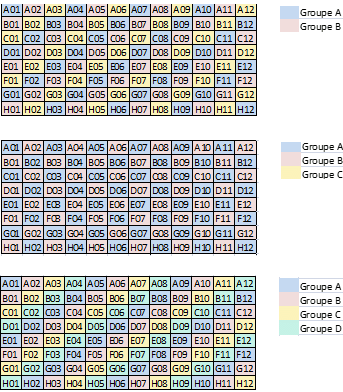
FFPE-derived samples must be handled independently: they must not be included on the same plate as standard genomic DNA and must be randomized separately.
For plates containing human samples, one well must be reserved for the internal positive control:
- Full plate: leave well H12 empty
- Partially filled plate: leave the first well following the last sample empty, while respecting the required sample multiple for the array.
Required Containers
| Recommended 96‑well PCR Plates | Unaccepted 96‑well Plates |
|---|---|
| Full‑skirt PCR plates: – BioRad Hard-Shell 96-Well PCR Plates, skirted, Cat# HSP9601 – BioRad Microseal PCR plates 96-well clear, Cat# MSP9601 – Eppendorf twin.tec, Cat# 951020401 – Corning Thermowell GOLD, Cat# 3752 – Axygen 96-well PCR Microplate, Cat# PCR96FSC Half‑skirt PCR plates: – Life Technologie Thermo-Fast 96 PCR detection plate with flat deck, Cat# AB1400L – FroggaBio 96-well plate, standard semi-skirted, clear, Cat#SS-96S | – 96‑well cell culture plates – Opaque PCR plates – No‑skirt PCR plates |
| Recommended adhesive films: – Adhesive PCR Films; Thermo Fisher Scientific, Cat#AB-0558 – MicroSeal ’F’ Foil; Bio-Rad, Cat# MSF-1001 |
Service Request Form and Sample Submission
Click on request a service and submit samples to view the instructions.
Sample Shipment Preparation
Click here for instructions on preparing samples for shipment.
Transmission of Results
An automated message from Nanuq is sent to the project contacts upon completion of the project.
Analysis files are directly accessible through the Nanuq web application, under the Genotyping Reports section, as well as within the Documents, Analysis Reports, and Downloadable Data tabs.
All samples are retained for three (3) months following the project completion date.
Version 1.0_2026-07-16